
TMS Therapy in Somerset West | Psychiatrist-Led Treatment
A targeted therapy for treatment-resistant
mental health conditions
Transcranial Magnetic Stimulation (TMS) Therapy
If you’ve been living with persistent depression, anxiety, or OCD — despite trying medication or talk therapy — Transcranial Magnetic Stimulation (TMS) may offer a new way forward.
This non-invasive, evidence-based therapy is now available through my private psychiatric practice in Somerset West, serving patients across Stellenbosch, the Winelands, Cape Town Metro, Overberg and the broader Western Cape.
Who might benefit from TMS?
TMS may be suitable for individuals facing ongoing mental health challenges where standard treatments have been ineffective — as well as for certain neurological and complex clinical presentations.
Referrals are accepted from Psychiatrists, General Practitioners, and Psychologists, and self-referrals are also welcome.
To determine suitability, a clinical assessment is required.
Learn more about our Referral process.
Mood & Anxiety Disorders
Adults living with major depressive disorder (MDD) or treatment-resistant depression (TRD)
Individuals with anxiety or OCD where symptoms persist despite standard treatment
People seeking alternatives to long-term medication
People experiencing suicidal ideation despite adequate standard care
Cognitive & Fatigue-Related Conditions
Patients with chronic fatigue or cognitive symptoms, assessed on a case-by-case basis
Patients with early-stage Alzheimer’s dementia or mild cognitive impairment, in combination with cognitive training
Neurological & Physical Health
Patients with neuropathic pain
Individuals recovering from stroke with speech or motor impairments
Patients with complex pain syndromes
Other Conditions with Emerging Evidence
People living with schizophrenia with prominent negative symptoms (e.g. apathy, flat affect)
Clinical trials also show promising results for conditions such as fibromyalgia, smoking cessation, Parkinson’s disease, PTSD, and lower-limb spasticity in multiple sclerosis
How does TMS therapy work?
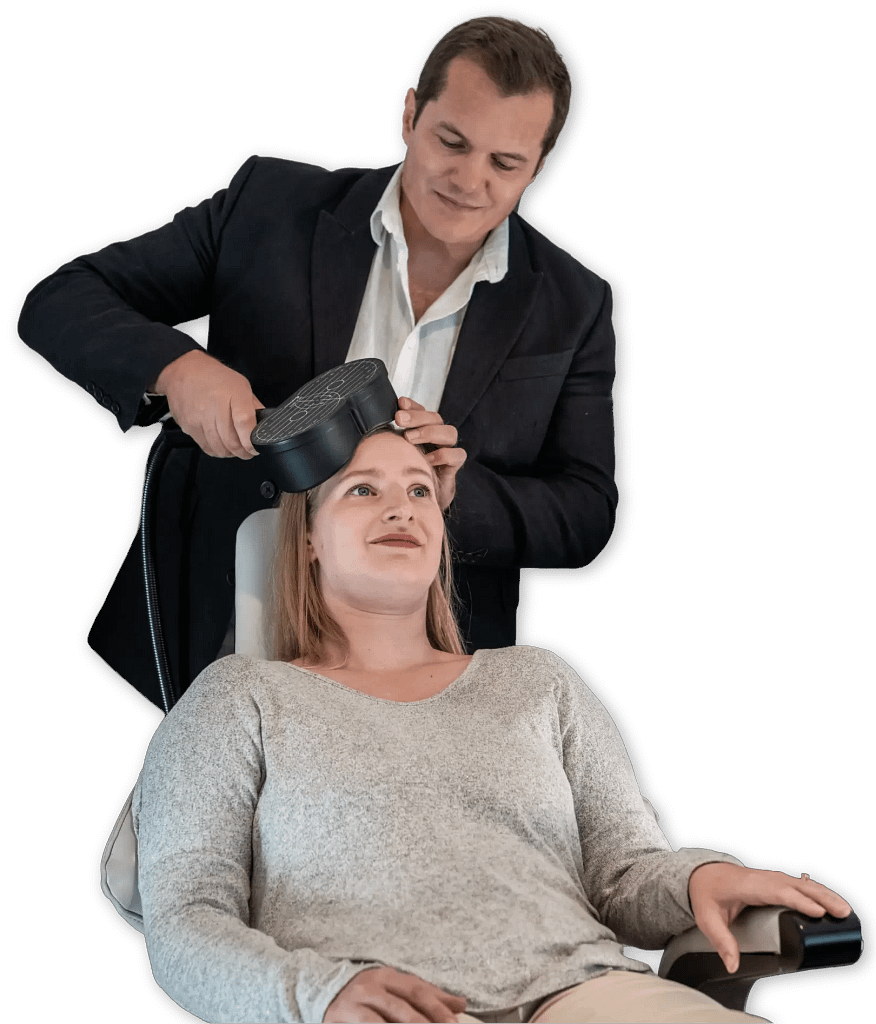
TMS uses magnetic pulses to stimulate areas of the brain involved in mood regulation.
These targeted pulses promote neuroplasticity — the brain’s ability to form new connections — and can support improved mental health without the need for medication or sedation. Sessions are non-invasive, pain-free, and take place on an outpatient basis.
What to expect from the TMS process
TMS is delivered in a series of outpatient sessions using a specialised device:
1. Initial consultation
A referral or enquiry is followed by a comprehensive clinical evaluation.
2. Safety screening
Includes a review of medical history and potential contraindications (e.g. seizure risk, metal implants, cochlear implant).
3. Motor threshold mapping
The first session includes calibration for individualised dosing.
4. Treatment sessions
Standard courses typically involve 30 sessions over 6 weeks; accelerated protocols may also be offered.
5. Monitoring and follow-up
Progress is tracked throughout, with maintenance options available where clinically indicated.
Benefits of Transcranial Magnetic Stimulation (TMS) therapy
- Non-invasive and drug-free
- Minimal side effects
- No downtime or recovery period
- Safe to use alongside most medications
- Clinically approved in South Africa and globally (FDA and SAHPRA)
Medical aid authorisation
TMS for treatment-resistant depression is covered by some South African medical aids, subject to authorisation. My practice assists with relevant ICD-10 codes and supporting documentation.
Patients are advised to confirm cover with their scheme.
Safety and Clinical Evidence
TMS is approved by the FDA, CE, and SAHPRA. It has a favourable safety profile and is especially effective for individuals who have not responded to at least two prior treatments for depression.
Common side effects
- Mild scalp discomfort
- Temporary headache
Contraindications
- History of seizures or epilepsy
- Implanted metal devices in the head or neck
- Cardiac pacemakers or implants
Find answers to the most frequently asked questions about TMS therapy.
Common side effects
- Mild scalp discomfort
- Temporary headache
Contraindications
- History of seizures or epilepsy
- Implanted metal devices in the head or neck
- Cardiac pacemakers or implants
Explore in-depth information about TMS and its Clinical Benefits
Our articles offer real-world context, patient-focused information, and guidance to help you understand whether TMS therapy is best suited for you.

Transcranial Magnetic Stimulation (TMS) Therapy for Persistent Depression
TMS therapy for treatment-resistant depression may help when other options haven’t. Discover a non-invasive path toward better mental health.

Transcranial Magnetic Stimulation (TMS) Therapy for Persistent Depression
TMS therapy for treatment-resistant depression may help when other options haven’t. Discover a non-invasive path toward better mental health.
Frequently Asked
TMS Questions
Explore these frequently asked questions to help you feel more confident and informed about the TMS process.
If you’re ready to take the next step, book a consultation and we’ll guide you through what’s next.
Is TMS painful?
Most patients experience a tapping sensation on the scalp, which is well tolerated. Any discomfort usually decreases after the first few sessions.
Can I continue my medication during TMS?
Yes, in many cases TMS is used alongside existing psychiatric medications. This will be assessed during your initial consultation.
When will I notice improvement?
Some individuals begin noticing improvement within 2 -4 weeks, but full benefit often occurs after the complete course.
Do I need a referral?
Referrals are encouraged but not required. Self-referrals undergo additional clinical review.
Learn more about our Referral process.

Get in touch about Transcranial Magnetic Stimulation (TMS) Therapy
Complete the Contact Form or call +27 (0)21 852 8836 to book a TMS consultation. My team will assist you with a booking or any additional questions during practice hours.
An integrated, ethical approach to interventional care
TMS is offered as part of a broader, person-centred psychiatric practice that prioritises individual needs, safety, and clinical integrity.
Visit the Services page to learn more about additional options available through my practice.